Commodity trading · SaaS Blockchain 3i Infotech Dubai · 2024

A blockchain-based commodity trading platform for a leading Dubai-based company.

A SaaS platform for high-volume commodity trading on blockchain, built to serve traders, market-makers, and ecosystem partners with a single auditable settlement layer. At 3i Infotech I led the end-to-end UX. I owned UX strategy, the design system, and the trader-desk experience . The highest-stakes surface in the product.

Role
UX Lead
3i Infotech
Team
1 PM · 2 designers
· 14 engineers
Duration
2024 · ~6 months
discovery → live
Outcome
Trader desk · OMS
· settlement console
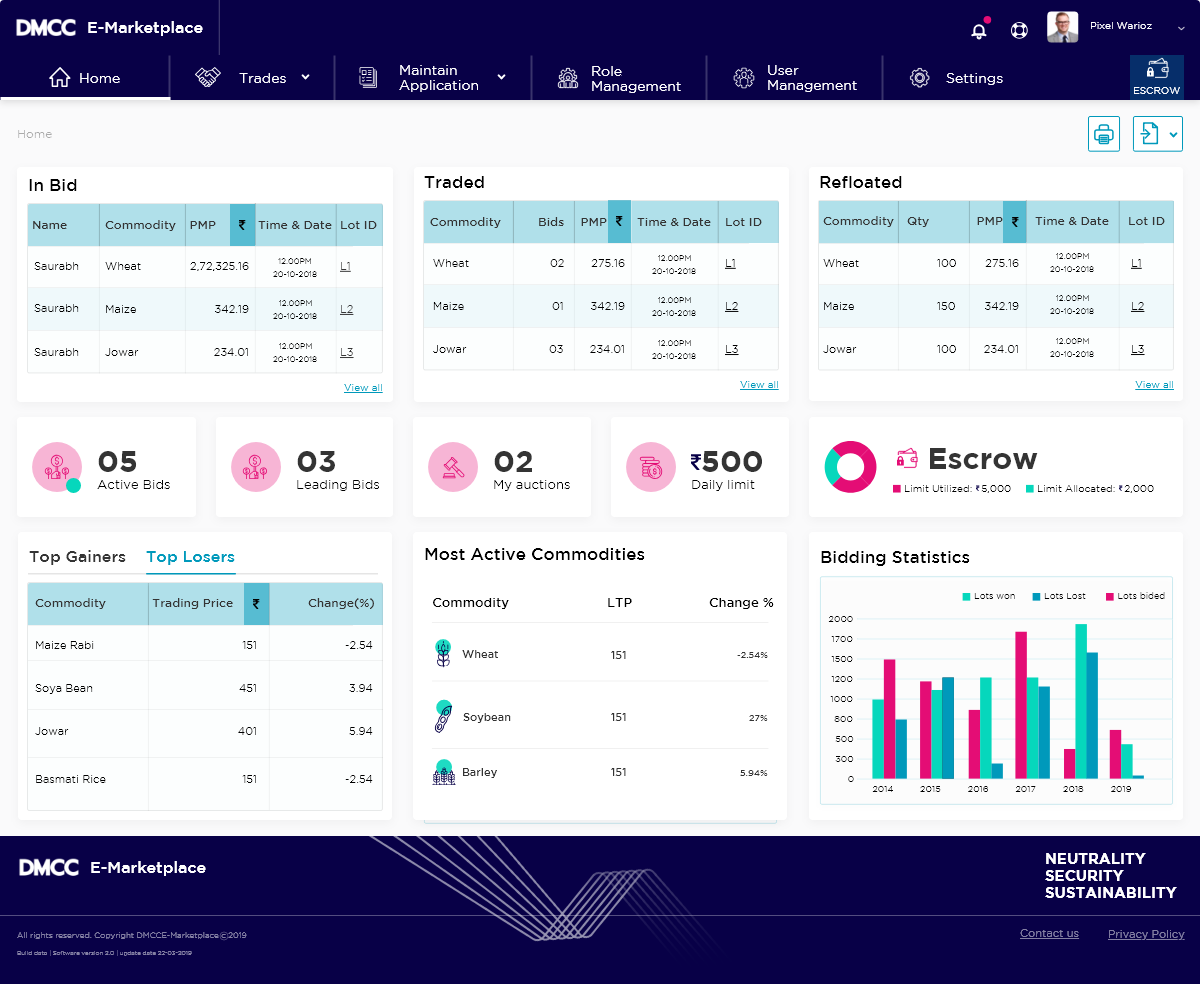
DMCC e-marketplace home dashboard with live bids, traded lots, escrow limits and bidding statistics
Live screen Home dashboard · live bids, traded lots, escrow limits and bidding statistics
01 · Problem

Commodity trading is opaque, slow, and trust-starved.

Traditional commodity trading runs on bilateral phone calls, paper LCs, multi-day settlements, and trust relationships built over decades. For a Dubai-based commodity house targeting global supply chains, that model was no longer scalable. They needed a SaaS platform that brought institutional-grade trading UX to commodities, with blockchain settlement to remove the multi-day clearing and counterparty risk.

The platform's success was contingent on a second, equally hard problem: building partnerships across the commodities ecosystem. A trading platform with no counterparties is a brochure. From day one, the product had to onboard market-makers, exporters, banks, and clearing partners, each with their own KYC requirements, compliance regimes, and operational rhythms. Onboarding had to be fast enough that a partner's compliance team would say yes, and rigorous enough that the platform's compliance team would let them on.

"Our customers shouldn't have to choose between Bloomberg-grade UX and counterparty trust. We have to deliver both, a settlement layer they can audit, and a partner ecosystem they can rely on." (Client product head, kickoff)

Core problems:

  • Information density without overload: traders need every depth row, but cognitive load kills accuracy.
  • Settlement must be visible: chain hash, status, and finality are part of the UX, not back-office noise.
  • Order errors are catastrophic: fat-finger protection, confirmation flows, override audit trail.
  • Multiple personas: traders, market-makers, ops, compliance, overlapping but distinct surfaces.
  • Partner onboarding is a product surface: fast for partners, rigorous for compliance, and visible to the trader who needs to know who they're dealing with.
02 · Process

Trader interviews first, then engineering reality-checks, then design.

Trading-floor UX is unforgiving. Get one trade ticket layout wrong and you've taught 100 traders to make mistakes 1,000 times a day. We started with deep contextual interviews with 8 commodity traders across two desks, and a parallel sync with the smart-contract / settlement engineering team to map what state the UI could and couldn't show.

  • Weeks 1 to 3. Trader research: shadowed open-trading sessions; quantified attention patterns (eyes never leave depth + chart for > 1.5s).
  • Weeks 3 to 5. Settlement reality: mapped every chain state and exception path with eng; settled on 4 user-facing settlement statuses (PENDING, CONFIRMED, SETTLED, EXCEPTION).
  • Weeks 5 to 8. Trader desk design: three-pane layout, tickets in muscle-memory positions, confirmation flows tuned per order size.
  • Weeks 8 to 14. System + ops: back-office consoles, compliance views, partner onboarding, reporting.
  • Weeks 14 to 24. Polish, cohort tests, launch: closed beta with 12 traders → general availability for the client's institutional book.
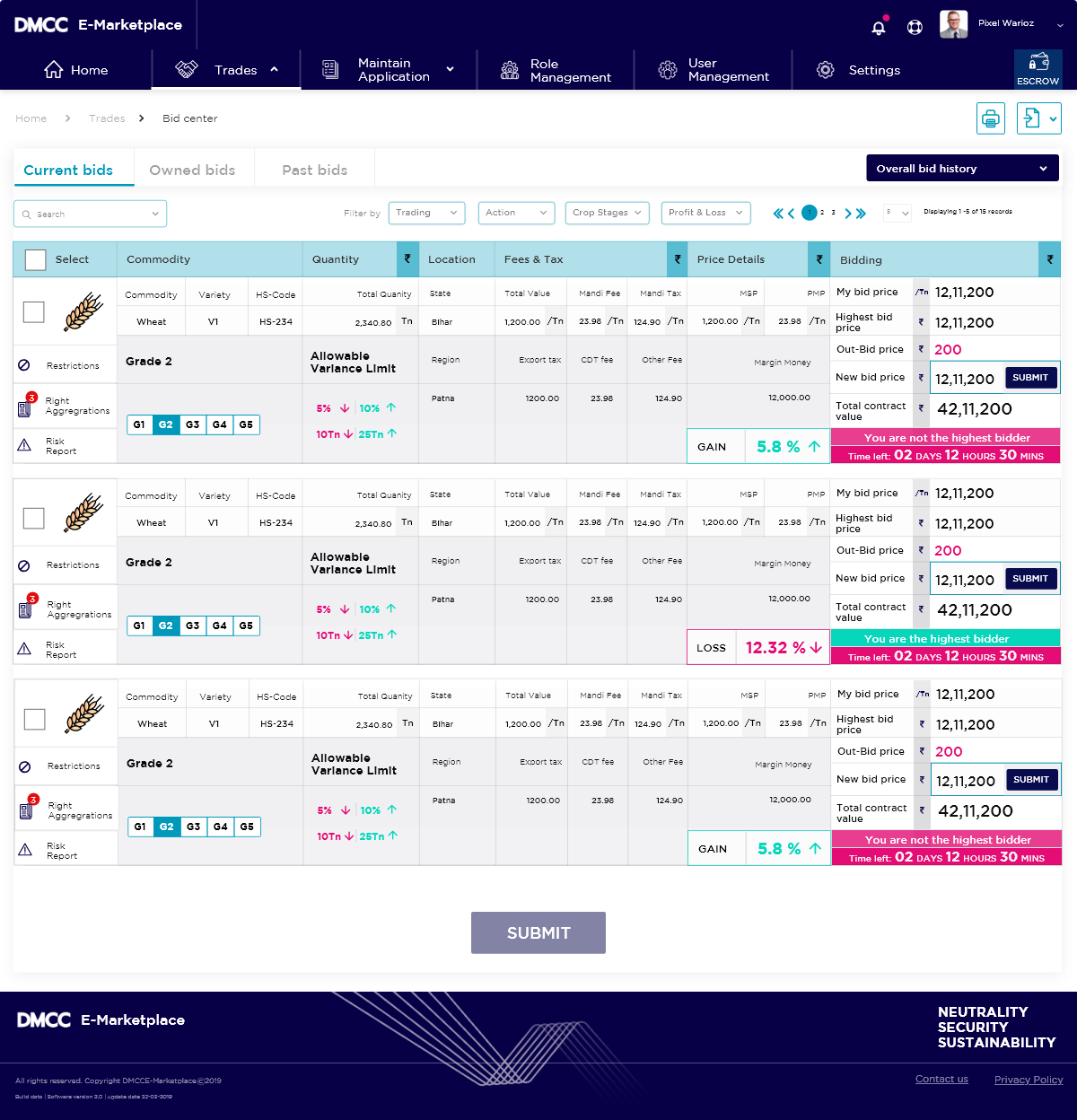
Bid center showing current bids with quantity, fees, price details and live bid status per lot
Live screen Bid center · every lot carries quantity, fees, price detail and its own bid state
03 · Design system

Trading UI tokens, fat-finger guards, and a settlement state model.

The palette does one job: tell a trader where they stand without reading a number. Teal means you are winning the lot, magenta means you have been out-bid, and the two never appear for anything else. Navy carries the chrome and every primary action, so a submit is always the darkest thing on the screen.

brand.navy
#080047
state.winning
#06D7BC
state.outbid
#E40D75
surface.tablehead
#B2E0EA
accent.sort
#58BCD2
link.active
#0099BB
Surfaces
5 surfaces. Trader desk, Settlement console, Ops, Compliance, Partner portal
Components
140+ trading-grade components, depth tables, tickets, blotter, chain hash chips
Fat-finger guards
Order size threshold → confirmation modal · price drift threshold → re-arm before send
Settlement model
4 user-facing states: PENDING · CONFIRMED · SETTLED · EXCEPTION, with chain hash + explorer link
Localisation & data
Multi-currency, multi-tz, RTL ready · monospaced numerals · 4-decimal precision tokens
04 · Intelligence layer

Anomaly detection, not auto-trading.

No auto-execution. AI is purely advisory, flagging weird trades, drift on settlement, and compliance risk. The trader or compliance officer always decides.

✦ Trading

Fat-finger + off-book detector

Flags orders > 3σ from the trader's 30-day median size or > X% from VWAP. Surfaces as a modal-blocking confirm with a one-line reason.

DecisionAlways trader
False-positive rate< 6%
✦ Settlement

Settlement drift watch

Predicts settlement-time outliers based on network conditions and chain mempool depth. Alerts ops before SLA breach instead of after.

DecisionOps decides
SLA breach−18%
✦ Compliance

Wash-trade pattern flag

Detects circular trade patterns across counterparties; routes to compliance with the full trail. Compliance officer is the decision-maker.

DecisionCompliance owns
Audit loggedEvery step
✦ Onboarding

Partner KYC accelerator

Pre-classifies KYC documents, extracts fields, flags inconsistencies. Cuts onboarding time from days to hours; humans verify before signing off.

DecisionCompliance approves
Time saved~70%
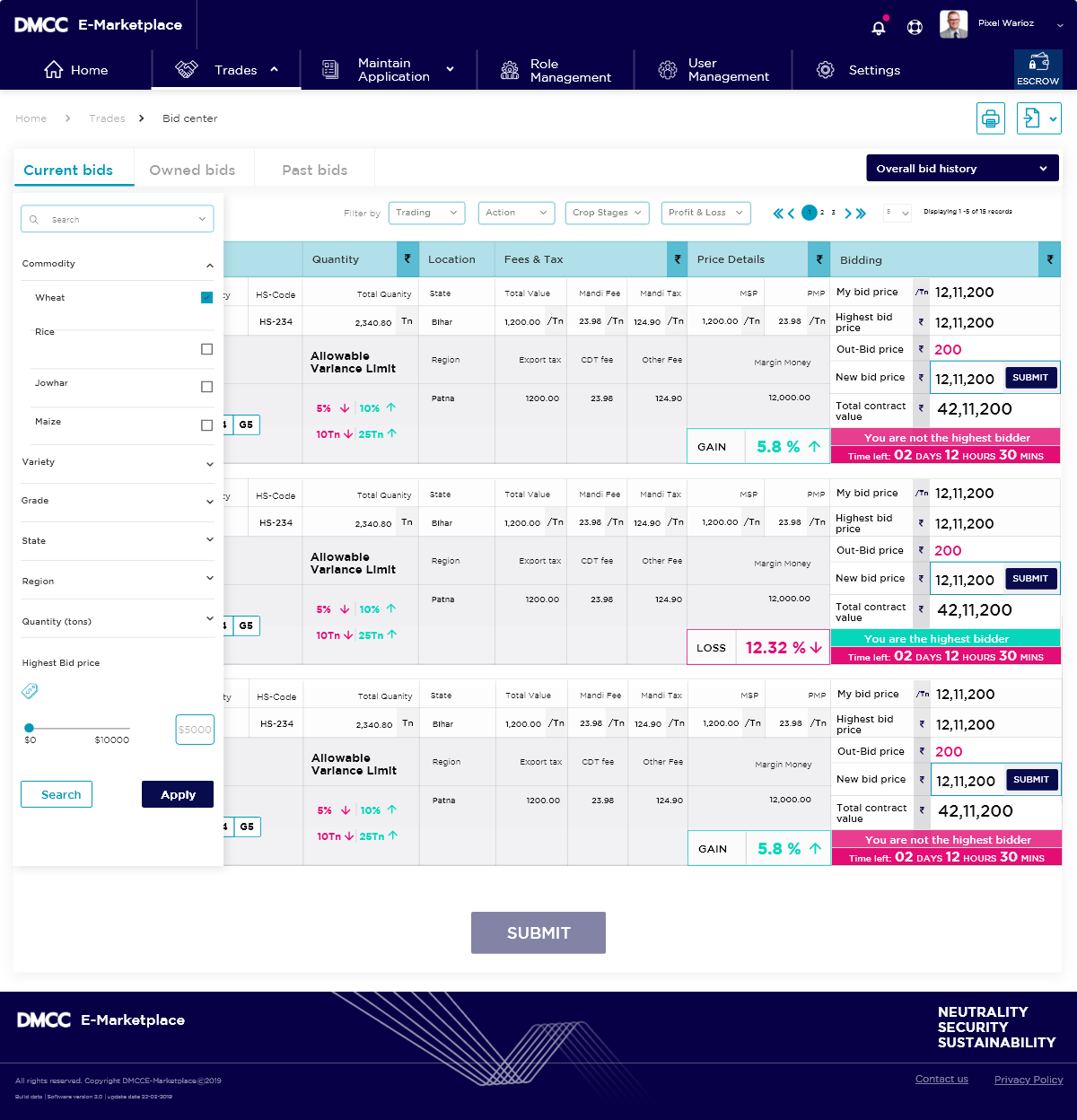
Bid center with the search panel open, filtering by commodity, variety, grade, state, region, quantity and bid price
Live screen Search panel · narrowing a crowded book by commodity, grade, region and price band
05 · What I owned

UX lead at 3i Infotech, trader desk & system.

UX strategy
Defined the trader-desk model, settlement state taxonomy, partner-onboarding flow, and persona-mapped surfaces across traders, ops, compliance, and counterparties
Trader desk design
End-to-end design of the highest-stakes surface, depth, tickets, chart, blotter, risk
Design system
140+ trading-grade components · fat-finger logic · chain settlement vocabulary
Engineering partnership
Daily sync with smart-contract + FE leads · co-defined the settlement state machine
Trader research
Contextual interviews with 8 commodity traders · closed-beta cohort with 12 traders
Stakeholder alignment
Weekly review with client product head · monthly steering committee
06 · Outcomes

Six months in: trader-grade UX over a blockchain settlement layer.

Figures are rounded and some client specifics are withheld under NDA. Counts are exact.

5
SURFACES SHIPPED
ONE COHERENT SYSTEM
140+
TRADING-GRADE
COMPONENTS
−18%
SETTLEMENT SLA
BREACHES
−70%
PARTNER KYC
ONBOARDING TIME
Eco
PARTNERS
ONBOARDED IN LAUNCH COHORT
12
TRADERS IN
CLOSED BETA
< 6%
FAT-FINGER FLAG
FALSE-POSITIVE
4
SETTLEMENT STATES
USER-FACING
~6 mo
DISCOVERY
→ LIVE
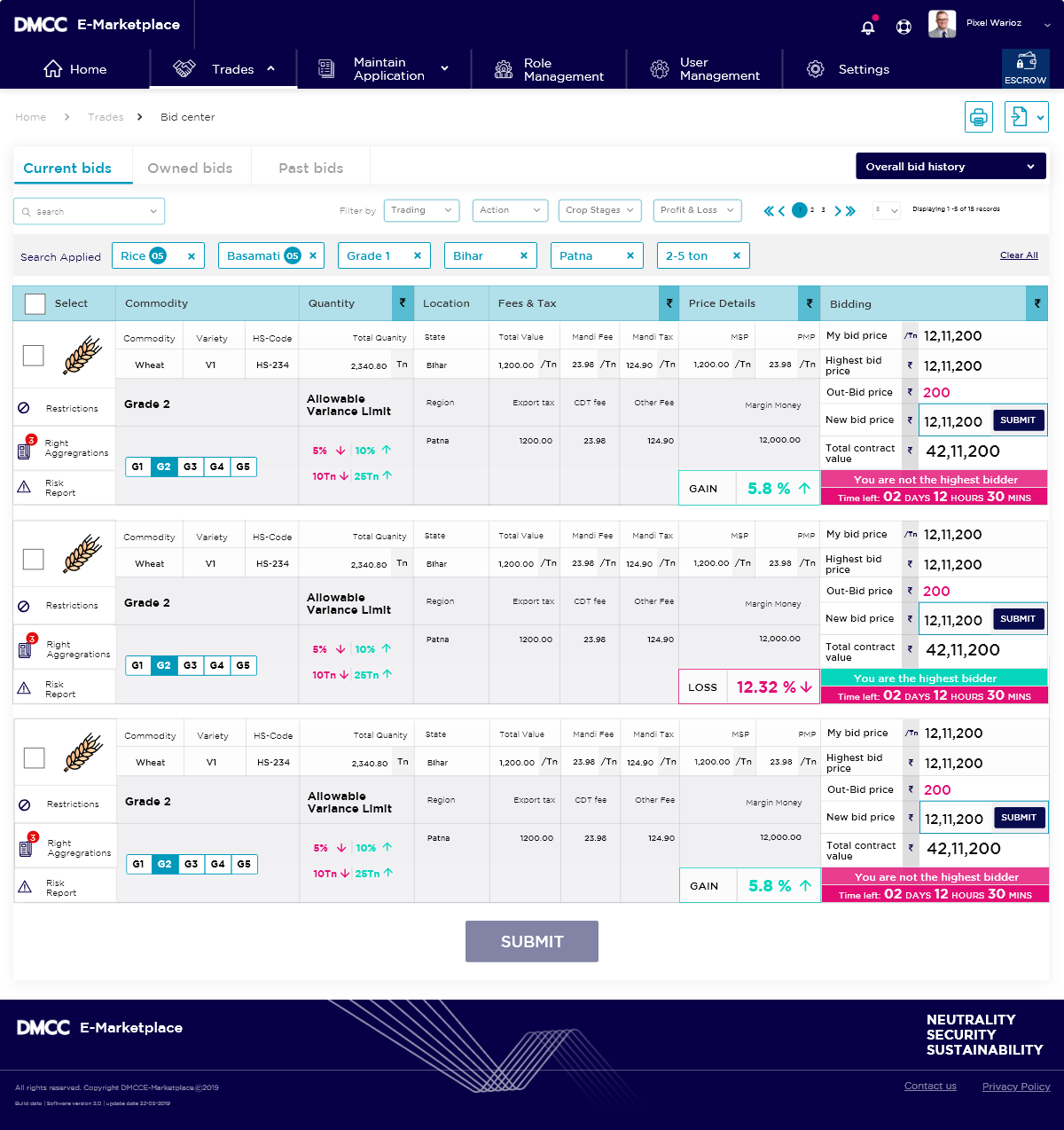
Bid center with applied filters shown as removable chips above the results
Live screen Filters applied · every active constraint stays visible and individually removable
07 · Reflections

What designing for real money taught me.

DO AGAIN

Co-design the state machine with engineering on day one. Settlement statuses were a UX problem disguised as a backend problem; treating them as one made every later decision easier.

DO AGAIN

Let convention do the heavy lifting. Borrowing from institutional terminals meant traders trusted the platform on day one. Novelty for novelty's sake would have killed adoption.

DO AGAIN

Fat-finger guards as a system primitive. Once we stopped treating them as a per-screen concern and made them a token-driven primitive, every order surface inherited the protection.

DO AGAIN

Treat partner onboarding as a product surface, not an admin form. Every counterparty we onboarded fast was a counterparty the traders trusted to trade against. Onboarding UX is liquidity UX, they're the same thing on different timescales.

DIFFERENTLY

Closed beta with traders earlier. We had a first cohort at week 14; week 8 would have caught two layout decisions before they got expensive.

DIFFERENTLY

Designed compliance & ops with equal weight from day one. Trader desk got 80% of attention early; ops/compliance had to play catch-up later.

LESSON

Blockchain explainability is a UX surface, not a footnote. Showing chain hash + status + finality is the difference between users believing in the settlement layer and not.