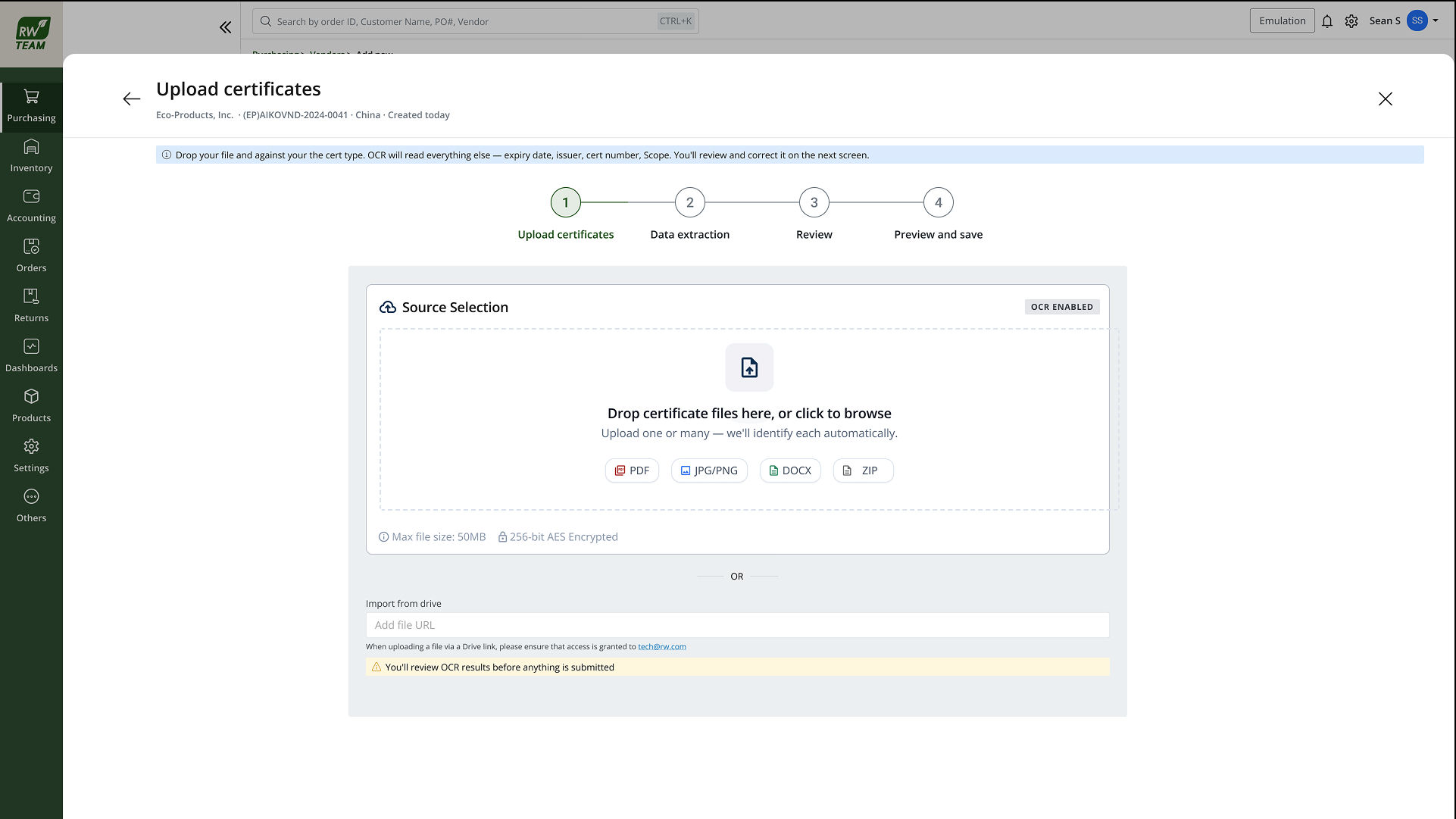
Compliance used to live in a spreadsheet. Now every certificate gets read on upload and checked against what the product category actually requires. Anything the model is unsure about goes to a person.
Want the full walkthrough, every edge case and the complete screen set? Read the detailed write-up.
Suppliers emailed PDFs. A coordinator tracked expiry in a spreadsheet that drifted from reality within weeks.
A buyer could raise a PO against a vendor whose certificate had already lapsed. The system had no way to know. On a food-contact supplier that is an audit finding waiting to happen.
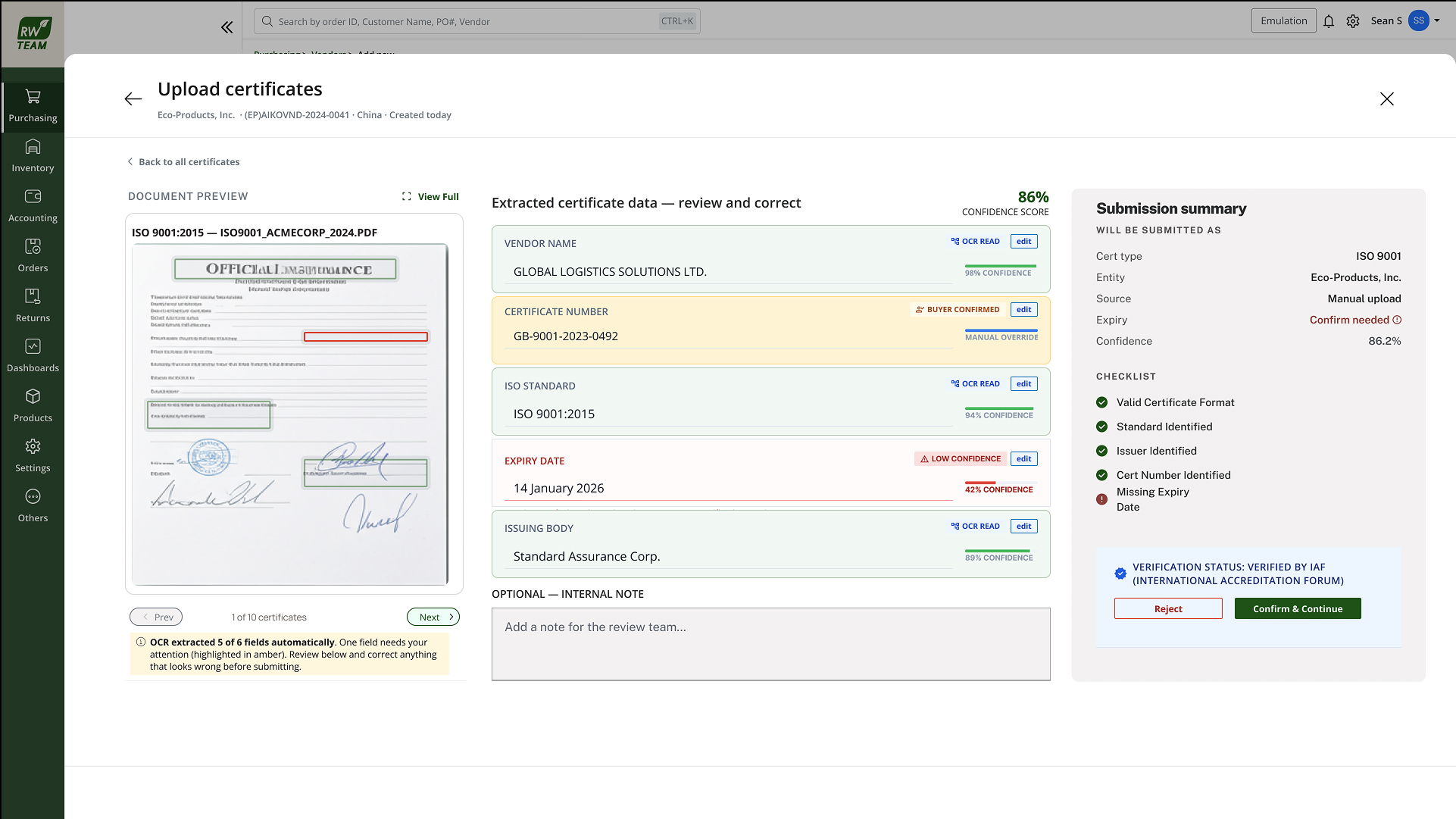
The model reads certificate type, issuing body, dates and scope. Poor scans still extract. Confidence drops instead of the whole thing failing silently.
Fields are checked against the product category's required-cert rules: right type, valid dates, scope covering what this vendor supplies.
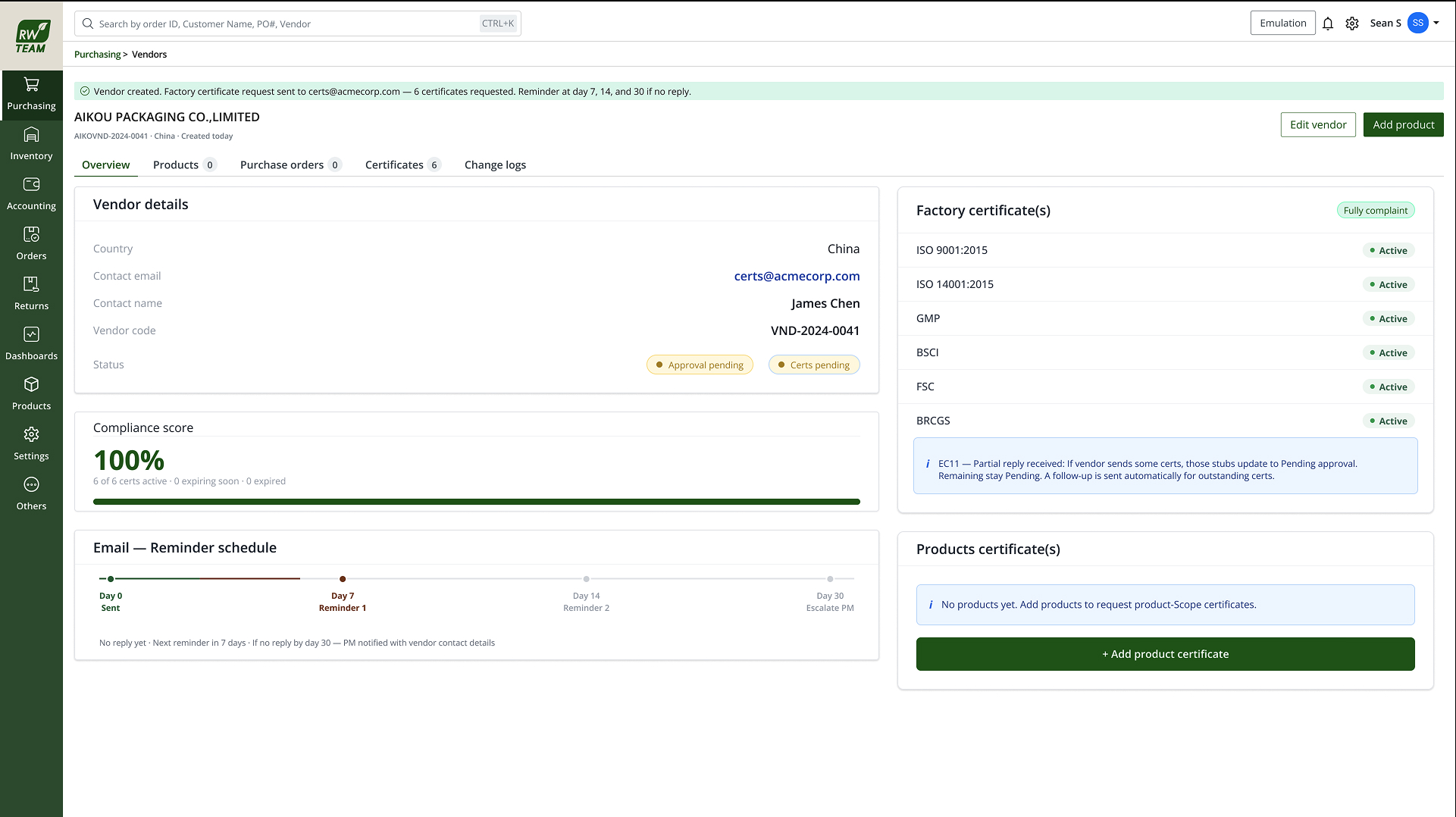
Missing, expiring or invalid certificates surface on the vendor profile, in the compliance dashboard, and inline when a buyer picks that vendor on a PO.
Every AI surface in the ERP uses one pattern, so a reviewer only has to learn it once.
A plain-language summary of what was read: type, expiry, scope. It comes before the fields.
A score on the overall read plus per-field confidence on ambiguous extractions.
Which regions of the document drove each field, and which category rules matched or failed.
Accept writes to the record. Edit lets you fix a misread before that happens. Dismiss is for when someone attached the wrong document.
Nothing enters the compliance record without an explicit accept, and every override is logged. Low-confidence extractions pre-fill but stay in pending review until a human confirms them.
Hard flag on the profile and a block on new POs for affected categories until a valid replacement is accepted.
Soft warning only. An unconfirmed extraction never hard-blocks a buyer on the model's word alone.
Across the first three months live, 85% of certificates were extracted, matched against category rules, and accepted without a reviewer correcting a single field.
The remaining 15% were low-confidence scans or unknown certificate types that needed a human to pick. That is the system doing its job.
One of eight AI use cases in the ERP. The AI cell is shared across all of them, so nobody has to rebuild trust in a new pattern each time.