In validation Enterprise procurement Foodservice packaging Trust-first AI

Parallel-scale support for one accountable buyer, without taking away ownership.

Sourcing managers carry every RFQ alone. I designed an AI-assisted experience that gives them team-scale support and an evidence trail. The human still signs the send.

Solo
LEAD PRODUCT DESIGNER
END-TO-END
2025 to 2026
CONCEPT →
VALIDATION
Delivered
HIGH-FIDELITY PROTOTYPE
+ VALIDATION PLAN
In validation
PROTOTYPE STAGE
NOT IN PRODUCTION

No production metrics yet. Numbers shown inside the prototype UI are illustrative, not measured results.
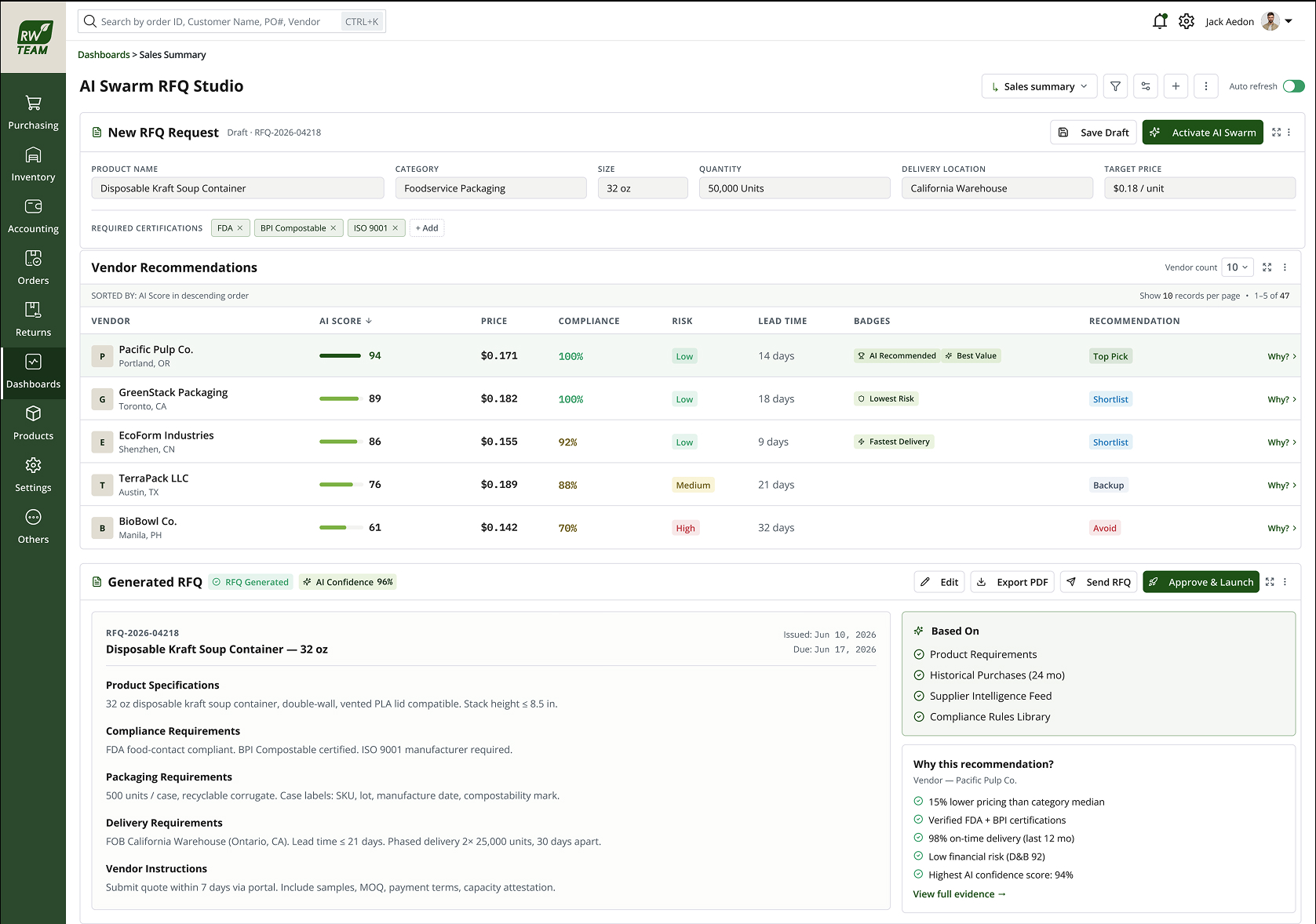
Supervised RFQ experience: vendor comparison, evidence drawer, and human approval gate
What I designed Analysis runs in parallel and every recommendation carries its evidence. The send stays human.
Open the live prototype

Opens in a new tab · high-fidelity prototype, not a production build

Want the full discovery, metrics framework and journey walkthrough? Read the detailed write-up.
01 · The Problem

The answer is scattered. That's where trust breaks.

One sourcing manager owns the entire RFQ: requirement, supplier shortlist, comparison, defending the choice to finance and compliance, then signing the send.

It runs on email, spreadsheets and tribal knowledge. No side-by-side comparison, no evidence trail. When finance asks "why this vendor?", the answer isn't in the RFQ.

02 · The Real Design Problem

Not automation. Supervised scale.

Not the problem

How do we fully automate sourcing?

The actual problem

How do we give one accountable person parallel-scale support without losing ownership?

That reframe set the ceiling on how much the system could do on its own. The interaction model, the evidence layer, the approval gate: all of it follows from that.

03 · What I Designed

One supervised workspace, requirement to send.

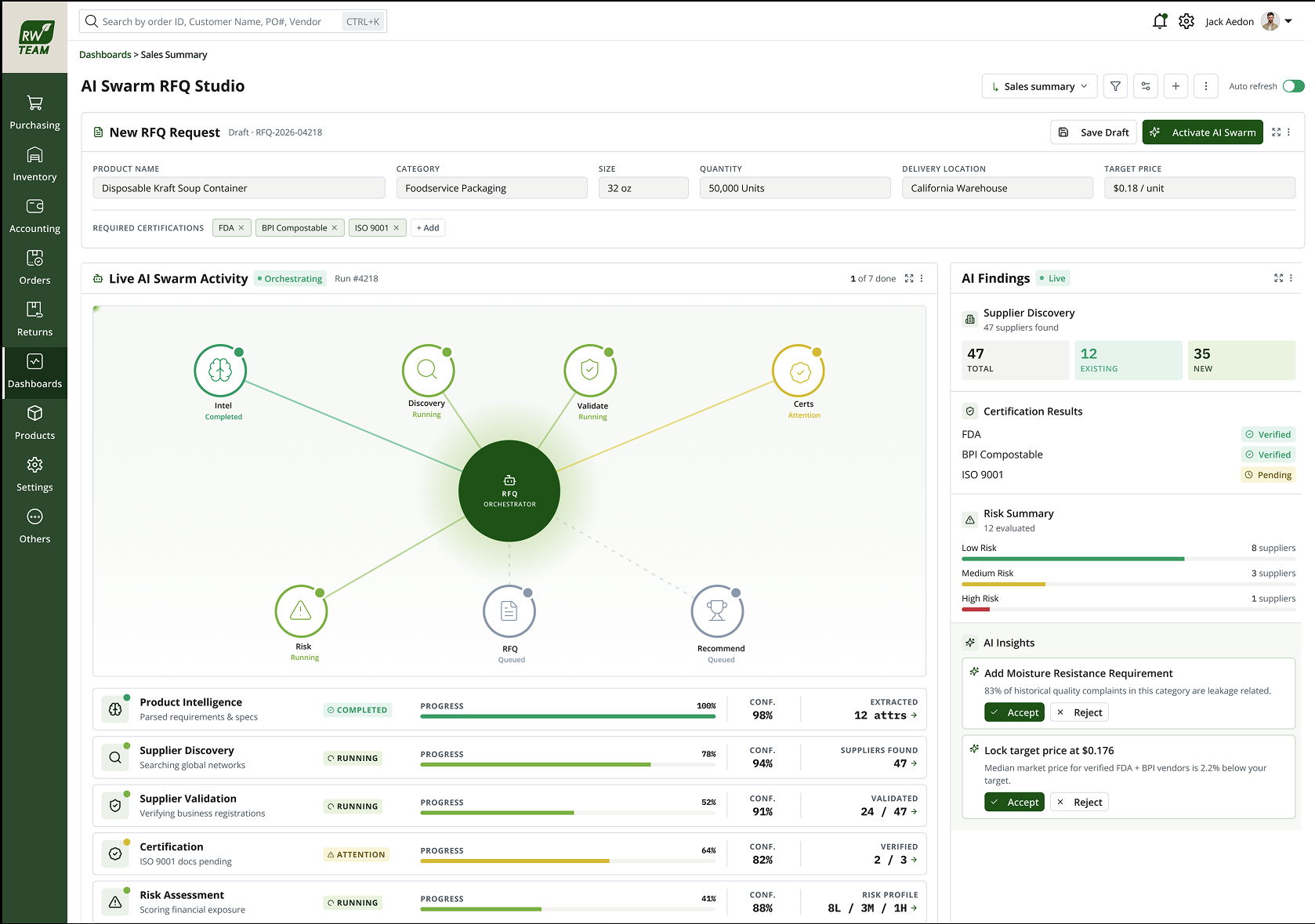
The manager states the requirement in one card. Supplier discovery, cert validation and risk analysis run in parallel after that, and findings land in one supervisable view as each finishes.

Recommendations arrive ranked and backed by evidence, each with a "why this?" drawer behind it. The manager can override or reject any of them, and the assembled RFQ sits behind a hard approval gate until someone signs.

Live supervision view with a findings feed and parallel analysis status
Supervise Findings feed sits above status, so exceptions surface before progress bars do.
Vendor comparison with evidence-backed ranking and a why-this drawer
Review & approve Evidence-backed ranking, and an approval gate before anything is sent.
04 · Principles

The rules that governed every trade-off.

The human remains accountable

AI proposes. The manager approves the send, and that accountability stays visible in the UI.

AI must explain itself

Every recommendation links to its evidence: pricing, certs, history, risk. Never a black-box score.

Reduce cognitive switching

Parallel work shows up in one supervisable view instead of being scattered across tools.

Design for exceptions

Pending certs, conflicting risk signals, missing specs. The happy path is the rare one.

Support expert workflows

Override, edit and reject without fighting the system. These users know more than the model does.

05 · Trust Model

AI recommends. The human sends.

Step 1

AI recommendation

Parallel analysis produces a ranked shortlist. It is a proposal, never a decision.

Step 2

Transparency layer

Sources, confidence and reasoning are inspectable on every recommendation.

Step 3

Human send gate

Irreversible spend stays human. Nothing leaves without explicit approval.

I explored three directions: an in-flow copilot, a dashboard-centric analysis view, and supervised parallel assistance. I rejected the first two because a skeptical sourcing manager couldn't inspect what they couldn't see.

Stakeholders asked for one-click launch. I pushed back: visible consent matters more than fewer clicks when the outcome is irreversible spend.

06 · Ownership

What I owned, and what I didn't.

I owned

  • Problem framing and the supervision-over-automation position
  • Procurement workflow redesign
  • Supervision view, explainability and approval patterns
  • High-fidelity prototype and the validation framework
  • Design documentation for the trust mechanisms

I did not own

  • Model training and prompt engineering
  • Backend infrastructure and agent implementation
  • Supplier data sourcing and compliance rule authoring
07 · Status & Validation

In validation, and labelled honestly.

Prototype stage, no production results. Success metrics are defined up front and tracked by status, but none are measured yet. Numbers shown inside the prototype are illustrative.

What we're testing

Whether a skeptical sourcing manager can inspect, override and defend an AI-assisted recommendation, and still feel it is theirs.

Defined up front

Time to a defensible RFQ draft, confidence explaining a vendor choice, and trust among skeptical buyers. Targets are set. No results yet.

08 · Reflection

Assistance people will actually sign their name to.

The hard part of AI in high-stakes work isn't capability. It is designing so the accountable person never has to take the system's word for it.
Principle carried forward · Enterprise RFQ