In validation Enterprise procurement Foodservice packaging Trust-first design

Helping procurement teams make high-stakes RFQ decisions, with confidence, speed, and accountability.

Sourcing managers carry every RFQ alone: finding suppliers, validating certs, comparing risk, defending the choice to finance, then signing the send. I led the design of an experience that gives them team-scale support without taking away ownership. AI assists. The human decides.

Role
Lead Product Designer
Solo · end-to-end
Timeline
2025 to 2026
Concept → validation
Partners
Sourcing advisors
Stakeholder reviews
Focus
Workflow · trust
Supervised assistance
Projected
TIME TO DEFENSIBLE
RFQ DRAFT
In test
CONFIDENCE EXPLAINING
VENDOR CHOICE
In test
TRUST WITH
SCEPTICAL BUYERS
Delivered
FULL PROTOTYPE
+ TRUST LAYER

No production metrics yet. Prototype UI numbers are illustrative. Not measured results.
Supervised RFQ experience: vendor comparison, draft document, and human approval gate
What we built An AI-assisted RFQ experience designed to help procurement teams review complex vendor submissions with greater confidence and transparency, before they sign the send.
My role

What I owned, and what I didn't.

Owned

  • Discovery and problem framing
  • Stakeholder alignment on supervision vs. automation
  • Procurement workflow redesign
  • Interaction patterns, supervision view, explainability
  • Trust and approval experiences, human send gate
  • High-fidelity prototype and validation framework
  • Design documentation for trust mechanisms

Did not own

  • Model training or prompt engineering
  • Backend infrastructure or agent implementation
  • Production AI engineering or deployment
  • Supplier data sourcing or compliance rule authoring
01 · The Problem

The answer is scattered. That's where trust breaks.

One sourcing manager owns the entire RFQ: shortlist, certs, comparison, document, send. No shared queue. No audit trail. Evidence lives in email threads and spreadsheets. When finance asks "why this vendor?" the answer is scattered. It is not in the RFQ. That's where trust breaks.

The gap

What gets in the way

  • Work runs through email, spreadsheets, and tribal knowledge
  • Purchase history and compliance rules live in separate systems
  • Comparison happens manually, if at all
  • The RFQ document doesn't capture the reasoning behind choices

The brief: give one accountable person a supervised path from requirement to send, with evidence attached, not reconstructed after the fact.

02 · Discovery

Grounded in shipped work, not a formal field study.

Grounded in shipped HikeOn ERP work, desk research, and informal conversations with sourcing professionals. No formal ethnography. The assumptions below guided decisions until validation could test them.

Stakeholders

Sourcing / purchasing

Owns the RFQ.

Compliance & finance

Reviews after the fact.

Operations

Bears the cost of errors.

Research methods

Domain immersion

Shipped HikeOn ERP work

Primary signal for this exploration.

Desk research

Patterns & benchmarks

Agentic UX and procurement product benchmarks.

Informal conversations

Sourcing professionals

Not structured ethnography. Shaped assumptions, not conclusions.

Key findings

Speed without explainability is a liability. Managers have to defend their choices.

Parallel workstreams run serially because one person coordinates everything.

Trust breaks when reasoning lives outside the RFQ document.

"The AI sent it" is not an acceptable outcome in procurement.

03 · Problem Definition

Jobs to be done, and where to focus first.

Primary user · Sourcing manager

Owns the RFQ end-to-end, carries accountability.

Jobs to be done
Functional

Get the RFQ right

Qualified suppliers, verified certs, comparable quotes.

Emotional

Sign with confidence

Feel confident hitting send.

Opportunity areas · ranked · tap to expand
P1

Trust & explainability

Without a human send gate and transparent reasoning, assistance won't be adopted.

P2

Serial bottleneck

One person coordinates discovery, validation, risk, and drafting.

P3

Fragmented data

Supplier intel, certs, and history live in different places.

P4

Late requirement gaps

Missing specs surface after draft, costly to fix downstream.

Focus: P1 and P2. Supervised parallel assistance with a trust layer and human send gate.

04 · Success Metrics

Metrics defined upfront, labeled honestly.

No production metrics yet. Prototype UI numbers are illustrative.

2
Projected
2
Estimated
3
In test
0
Measured
Projected Estimated In test Measured · none yet
Metrics by category · select a tab
Projected

Procurement cycle time

Method. Timed task runs vs. manual baseline.

Estimated

RFQ throughput per manager

Method. Directional, post-validation.

In test

Task completion without external tools

Method. Task-based sessions.

In test

Confidence explaining vendor choice

Method. Comprehension check post-session.

In test

Willingness to trust draft recommendations

Method. Observe accept / reject / override patterns.

Projected

Exception rate

Errors caught before send. Method. Error-injection tasks.

Estimated

Escalation to manual workflow

Method. Track manual override behavior.

05 · Design Principles

Principles that governed every trade-off.

PRINCIPLE

Human remains accountable. AI proposes; manager approves the send. Accountability must stay visible in the UI.

PRINCIPLE

AI explains itself. Every recommendation links to evidence: pricing, certs, history, risk. Not a black-box score.

PRINCIPLE

Reduce cognitive switching. Parallel work surfaces in one supervisable view.

PRINCIPLE

Progressive disclosure. Status and findings first; reasoning on demand.

PRINCIPLE

Design for exceptions. Certs pending, conflicting risk signals, missing specs. The happy path is rare.

PRINCIPLE

Support expert workflows. Override, edit, reject without fighting the system.

06 · Solution Exploration

Three directions. One earned the investment.

A · COPILOT IN RFQ

What it was. Chat pattern inside the flow.
Why rejected. Hides parallel state. Manager can't supervise workstreams they can't see.

B · DASHBOARD-CENTRIC ANALYSIS

What it was. Comparison / reporting after analysis.
Why rejected. Still serial. Improves visibility, not throughput. Feels like bolted-on BI.

C · SUPERVISED PARALLEL ASSISTANCE

What it was. Distributed work, human in command, inspectable reasoning.
Selected. Maps to how managers think about sourcing.

07 · The Experience

Decisions first, screens as evidence.

Select a step

Step 1 · Enter the requirement

One card, not a wizard.

Manager captures intent (product, quantity, certs, delivery, target price) before any assistance runs. System validates completeness and surfaces known cert requirements for the category.

NEW RFQ · REQUIREMENT Compostable food containers · 50,000 units BPI cert required Delivery · 6 weeks Target price · $0.08/unit Region · North America Start analysis
Early concept Managers capture intent in one card before any analysis runs.
Trade-off

Less "magic" on the first screen. Accepted, because this audience won't trust output they didn't define.

Step 2 · Supervise parallel analysis

Findings surface as work completes.

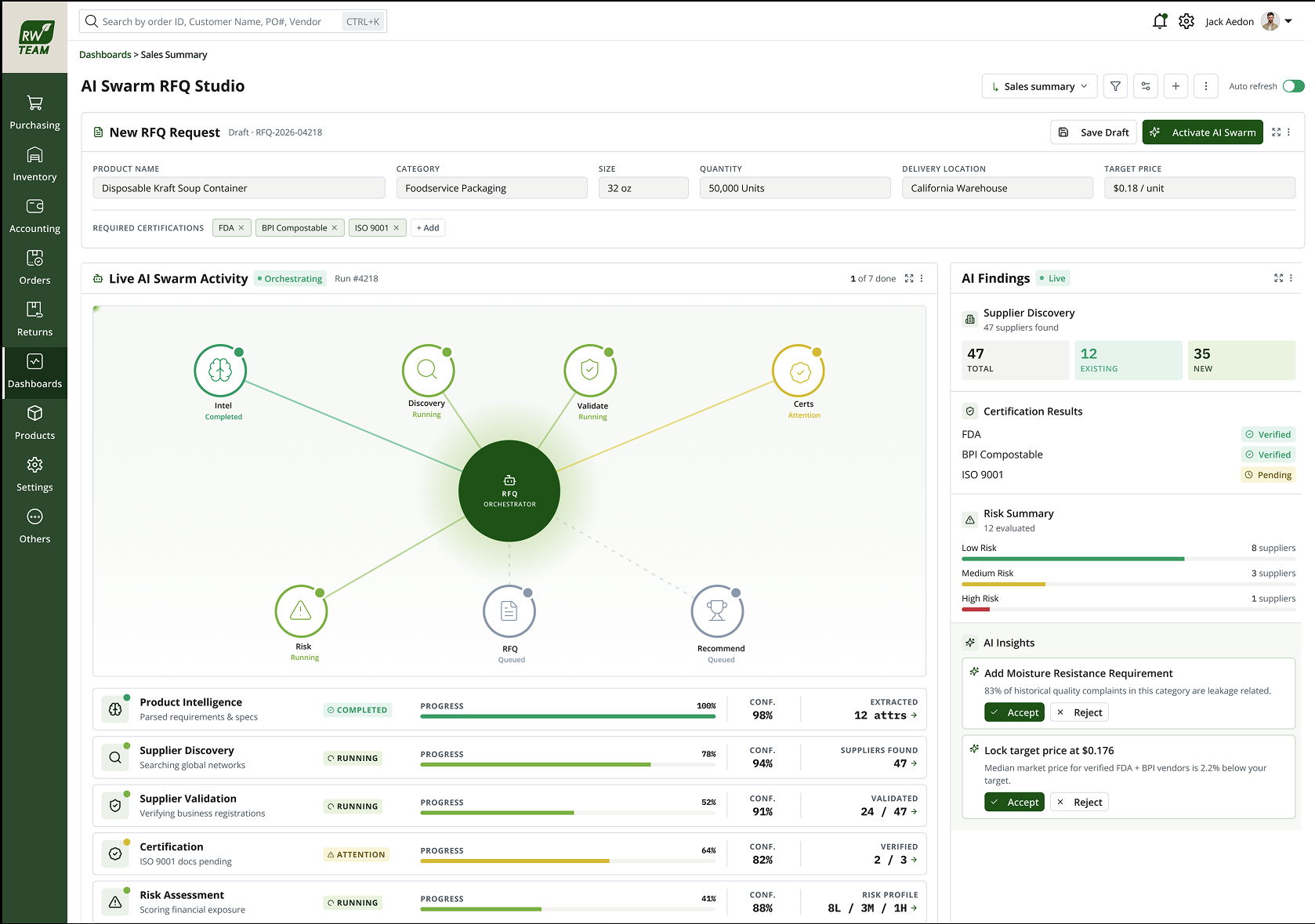
Live activity view and findings feed. Suppliers surfaced, certs verified or flagged, risk tiered, as work completes. Status and findings in one view, not seven tabs.

Live supervision view with findings feed and parallel analysis status
Evidence Suppliers, certs, and risk surface in one supervised view as work completes.
Trade-off

Information order. Findings feed above agent status, so exceptions surface before progress theatre.
Trade-off. More visual complexity than a chat copilot. Chose inspectability over demo simplicity.

Step 3 · Review recommendations and adjust

Proposals, not decisions.

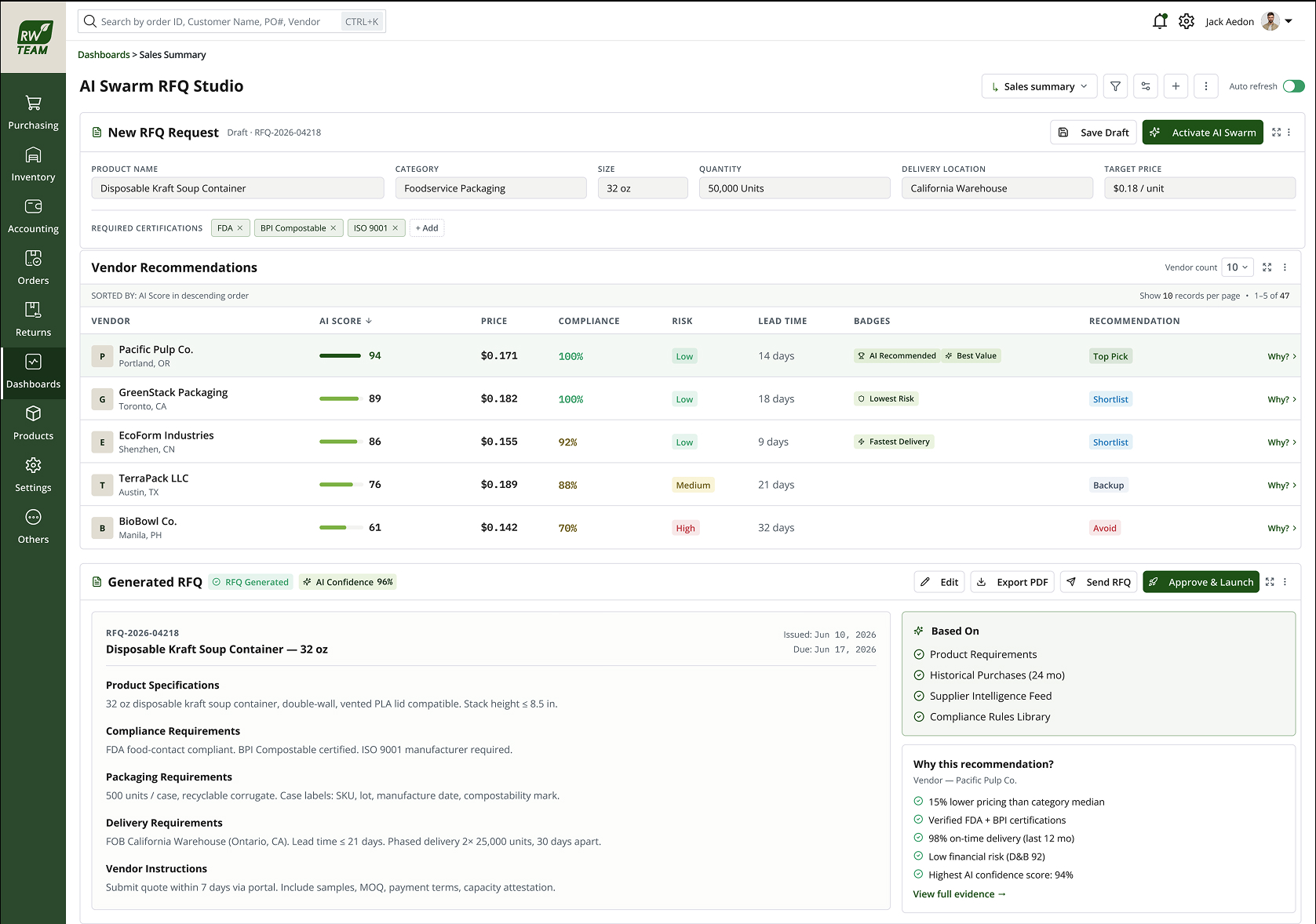
Comparison table with evidence-backed ranking. A "Why this?" drawer, not footnotes. Defending the choice is a job equal to finding it. Accept / reject insight cards; accepting re-runs the affected analysis.

Vendor comparison table with evidence-backed ranking and Why this drawer
Evidence Evidence-backed ranking with a "Why this?" drawer for every recommendation.
Trade-off

Accept / reject adds friction. Visible consent matters more than fewer clicks.

Step 4 · Approve and send

Irreversible spend stays human.

Draft RFQ assembled from requirement, history, supplier intel, and compliance rules. Editable document. Hard approval gate on send.

Generated RFQ document with Approve and Launch human approval gate
Evidence The assembled RFQ, with a hard approval gate before send.
Trade-off

Stakeholders wanted one-click launch. Pushed back. Irreversible spend stays human.